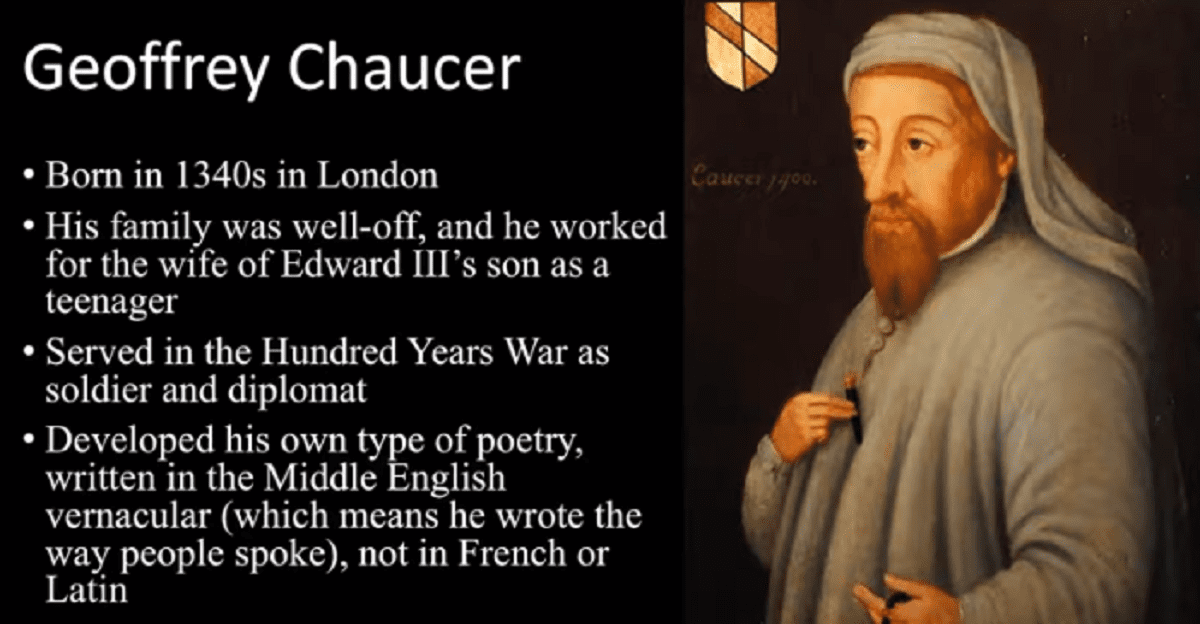
Geoffrey Chaucer died in 1400, during one of the turbulent periods in English History. This turbulence is the setting of Chaucer’s life. The black plague devastated Europe five times. One attack killed 50 thousand in London within a few months. The Hundred Years’ War between England and France was marked by intermittent periods of conflict and truce. The present uprising was crushed. Several powerful friends of Chaucer lost favor and were executed or fled.
The beginning of the 1960s is called Modern Literature, but to become more specific, it is also called early Modern Literature, and there must be a background to it in the social development that caused the rise of early Modern Literature.
The Canterbury Tales is one of the milestones of English Literature. The characters of the Canterbury Tales are so very varied in their characteristics that critics have called these characters God’s Splantee, which has created so many people, and all of them are represented in the book.
Geoffrey Chaucer: Writing The Canterbury Tales
Geoffrey Chaucer, writing The Canterbury Tales, set against a medieval backdrop symbolizing 14th-century England. The characters were created and introduced by Chaucer, and the most important thing that happens in this book is that each character is asked to tell a story. So, Chaucer leaves the range to each individual in a story. So, imagine Chaucer himself representing these stories, introducing a character, establishing his individual types, and making all of them tell their own stories. Chaucer took this inspiration from Boccaccio. He was a contemporary of Chaucer and lived in Italy. He wrote stories in this fashion.
Each character is asked to tell a tale. When you tell a tale, what happens in a way. You allow people to have a peek into your mind. The person who is listening to you understands what you want to say, what your performances are, which things you want to avoid, and which things you want to attack. So, in a way, the mental picture of a person becomes clear if we read a story. The interesting thing is that at the end of the tale, there is a discussion between the different characters.
When discussion happens, in the end, the discussion will help the characters in the telling of the next story. Chaucer’s characters are not static, but he showed them as learners who hear one another and take influences from one another, and develop into new persons. Chaucer’s characters are wrong characters who are always in the process of making themselves and producing themselves. The more we read about the characters, the more they become aware not only of contemporary history but of human nature.
Pilgrims’ Journey to Canterbury
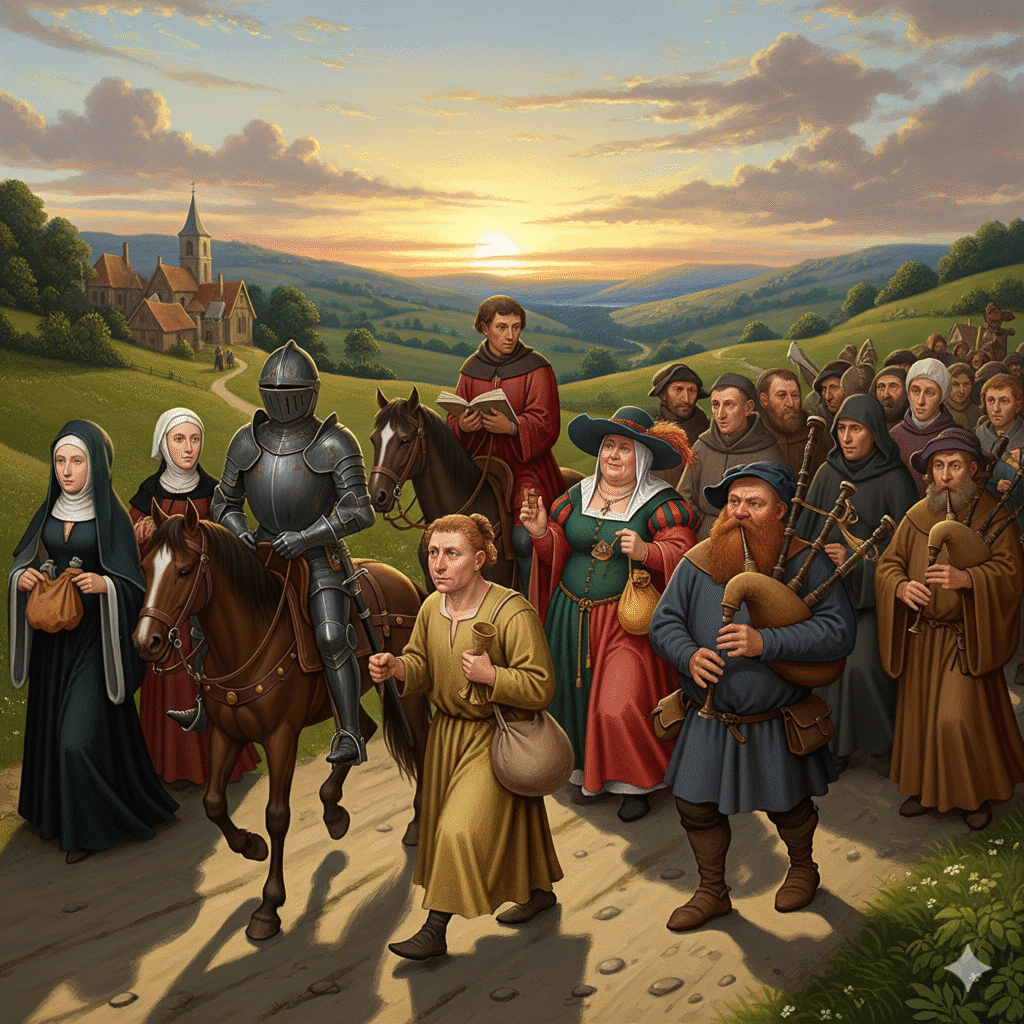
Medieval-style artwork depicting the diverse group of pilgrims from The Canterbury Tales on their journey to Canterbury. Chaucer is not talking about religion, nor talking about God; he is talking about actual human beings. This poem exemplifies secularism.
Chaucer is an old author. With him, modern English Literature begins. He is truly known as the father of English literature. Today, the English language is very elegant, very developed, and very precise, with a rich vocabulary, but the language in Chaucer’s time was not standardized.
Chaucer came from the upper hierarchy of society. Chaucer tells the story in the manner of a person who sings. He is not describing, he is telling. He was a man of the court and also performed ambassadorial duties. The prologue is an introduction, so he is writing an introduction to the bigger piece called the poem titled “The Canterbury Tales,” and this introduction is more than 100 lines.
The language adopted by Chaucer describes the owner of the inn as a host, and he is so excited that when he meets these people, he offers himself additional company.
He is sociable and mixes with people very well. The people are presented as pin portraits. Critics have called Chaucer’s prologue a portrait gallery.
Chaucer has tongue in cheek, sometimes pulling their leg. All of them were on their own horses, as traveling was only possible on horses. They were from different walks of life and professions, and they mingled, integrated here, and became a community. They gathered in a small town. The owner of the inn was a host, and he was so excited that he offered himself as additional company.
The formal beginning of The Canterbury Tales is set in April, a time when people traditionally began to travel, as the harsh conditions of earlier months made journeys difficult in England. Chaucer famously opens the prologue with the line Whan that Aprill with his shoures soote, referring to the sweet spring showers that stir life and inspire pilgrimages.
So, he talks of showers, birds singing, and flowers smiling; there is moisture, and this moisture is running through the veins of the birds and flowers. So, they have a new kind of life.
Iconic Characters of The Canterbury Tales
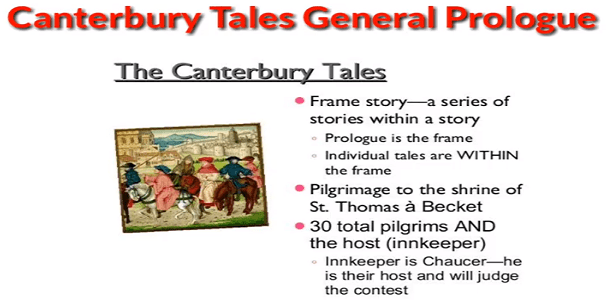
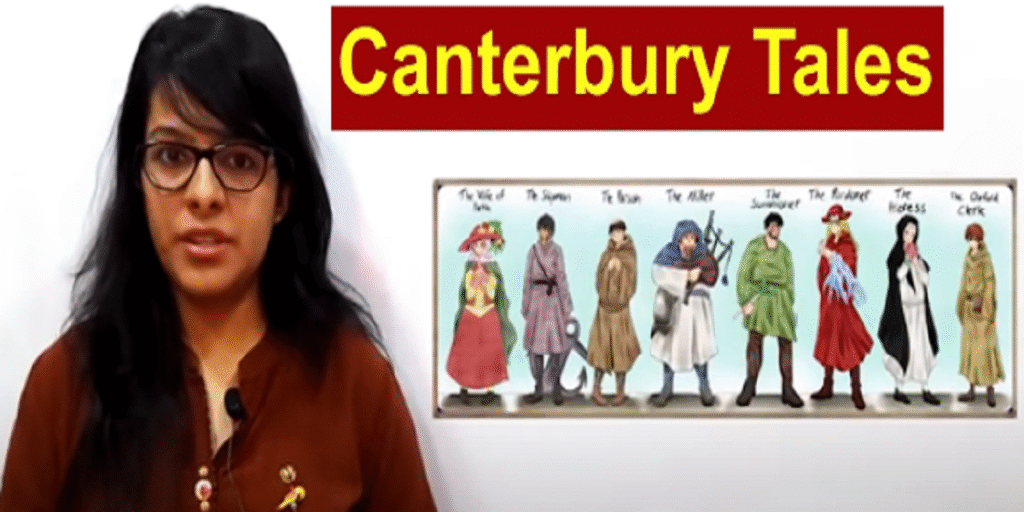
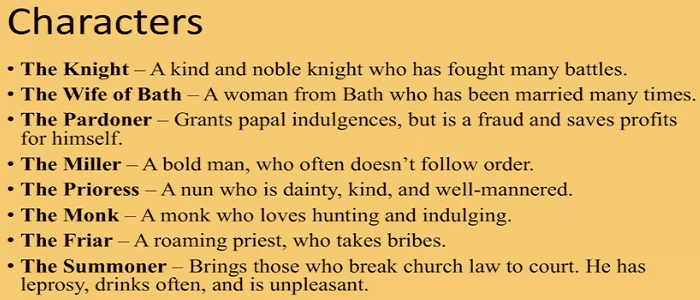
Artistic rendering of the Knight, the Wife of Bath, the Pardoner, and other iconic characters from The Canterbury Tales.
Chaucer was a masterful communicator, a true artist with words. He possessed the rare ability to weave language with such charm and wit that it effortlessly drew smiles from his listeners.
In The Canterbury Tales, he emerges not just as a narrator but as a warm, memorable presence, gentle, observant, and wonderfully human. He blends seamlessly with the very characters he sketches in the Prologue, offering vivid pen portraits of a remarkably diverse group. Even those who appear quiet at first hint at voices yet to be heard. No two characters are alike, not even the father and son, for the son is unmistakably shaped by a different world, a different time.
Chaucer does not tell us who they are in direct terms; instead, he lets them reveal themselves. He shows rather than tells—and in doing so, he invites us to discover them for ourselves.
The Knight
The knight is a widely traveled and perfect gentleman. This is said not tongue in cheek. He is a brave man. He is loyal to friends and masters. He denied a lot of pleasures and sacrificed all his personal things, but they don’t exist now, and they have been lost to history.
The Squire
He is the son of the Knight, who is twenty, and we associate this age with fun, courage, etc. If one is a lover, then one must be writing poetry.
The Yeoman
The third character is Yeoman. The phrase in the dictionary is yeoman service. He rendered a yeoman service, which means a loyal servant. Yeoman was like a bodyguard.
The Nun
Nun is a very simple soul. They believe in self-abnegation and self-denial, and prioritize service above all else. Nun is the one who is kind, nice, polite, and always helpful. She eats less and sleeps less, prays to God, and leads a simple life.
But Chaucer’s run is entirely different. She is called, for instance, “Madame Eglantine”. She speaks French. She is fashionable. She was an Englishwoman and tried to inculcate the French, so it was English French, not the French that was spoken at the time in France. She uses it to her advantage. So she is a very clever person. She uses it to impress others.
She has good table manners. She eats in style. She holds the spoon steadily. She puts it in a cup. The spoon travels from her hand to her mouth without spelling anything along the way. When things have reached the mouth, she wipes her lips clean, and this amuses us, as this person is known as very simple, but this woman enjoys eating. Chaucer talks about the sauce. It means sauce was there in Chaucer’s time. She is cheerful and elegant. She has a behavior that she must learn from somewhere. She is not a good bread person. She is not from that kind of family.
Chaucer exposes her hypocrisy. She shows imitative behavior. When she sees a mousetrap, tears arise in her eyes, but on another occasion, she feeds her hounds with roasted meat.
She has a tender heart. She wears ornaments, and she likes ornaments very much. Chaucer is satirizing, but in a mild manner. He is enjoying their company. The nun adds a kind of spice to life.
It can be said that Chaucer is satirizing religion and moral principles. In that sense, Chaucer is not exactly a satirist. He has a good sense of humor. He is a good-humored soul. He treats all the characters like children, like a grandfather satirizing his grandson.
The great humanists have learned from Chaucer. He can’t hate people. One can talk about certain habits of some, but those habits are examples of certain restrictions that society puts on them. So there is a clash in every human being between what the human being wishes and what one human being is expected to perform or do in life, and that clash is fun.
The Monk
Monk is a manly man. He owns valuable horses. He is a state supervisor, supervising the church. He also likes hunting. He is a hard rider. He has a pack of hounds. His boots are of good leather, and Chaucer has given him 42 lines in the prologue.
The Narrator Geoffrey Chaucer
The narrator in The Canterbury Tales, often identified with Geoffrey Chaucer himself, presents a curious, observant, and good-natured voice. He mingles easily with the pilgrims, offering vivid sketches of each without harsh judgment. Though he claims naivety, his subtle wit and sharp eye reveal a deep understanding of human nature. Through his gentle humor and keen storytelling, he invites readers to see each character in their full complexity.
The Host Harry Bailey
Harry Bailey, the Host of the Tabard Inn, is a lively, commanding, and good-humored figure who proposes the storytelling contest to entertain the pilgrims on their journey. He is practical, sociable, and quick-witted, often stepping in to guide the group and keep order. With a strong personality and a flair for leadership, he brings energy and structure to the pilgrimage.
Explore more literary insights in our English Literature category.
Character Sketches from The Canterbury Tales
Geoffrey Chaucer’s The Canterbury Tales presents a rich gallery of medieval life through a diverse group of pilgrims. Each character reflects a different profession, personality, and social class, offering readers a vivid picture of 14th-century England.
Below are detailed portraits of the remaining important characters.
The Prioress (Madame Eglantine)
The Prioress, also known as Madame Eglantine, is one of Chaucer’s most gently satirized characters. Although she is a nun, she behaves more like a refined lady of high society than a woman devoted to religious austerity.
She speaks French with an English accent, not the proper Parisian French, which Chaucer humorously notes to show her desire to appear cultured and fashionable. Her table manners are elegant. She eats delicately, wipes her lips carefully, and never drops a crumb, traits that suggest courtly training rather than convent discipline.
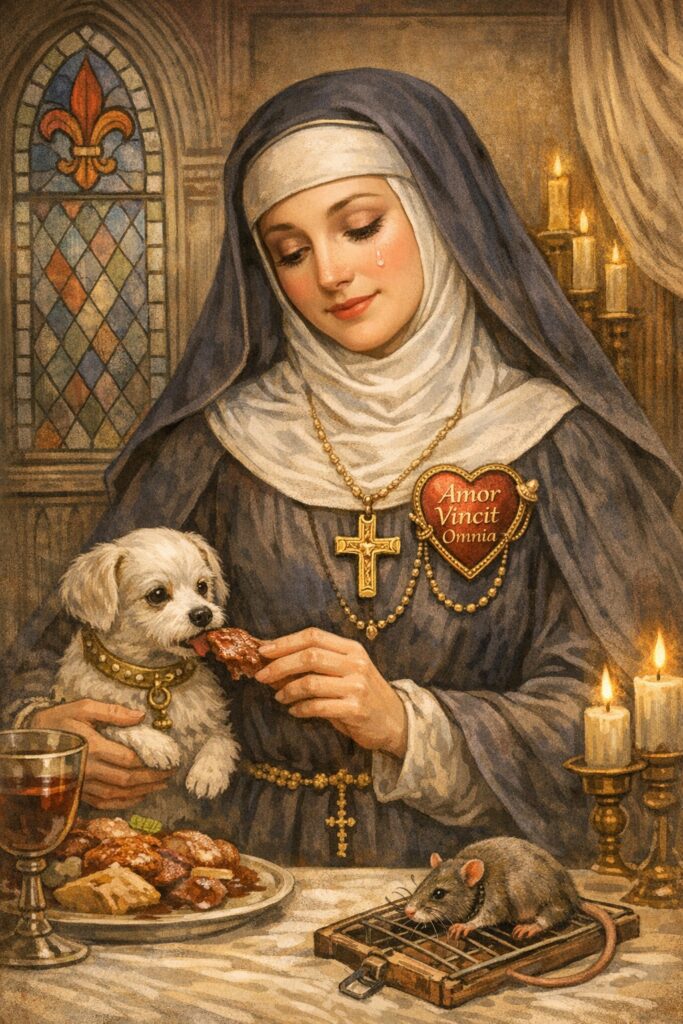
The Prioress is extremely sentimental. She weeps if she sees a mouse caught in a trap and shows deep affection for her small dogs, even feeding them roasted meat and fine bread. This tenderness appears kind on the surface, yet Chaucer subtly hints that her compassion is selective, more for animals and appearances than for the poor and suffering humans she should serve.
She wears a brooch engraved with the words “Amor vincit omnia” (“Love conquers all”), a phrase that suggests romantic love rather than spiritual devotion. This detail adds to the irony of her character, showing how worldly emotions have quietly replaced true religious commitment.
Through the Prioress, Chaucer does not attack religion itself but gently exposes how easily spiritual life can be softened by vanity, comfort, and social ambition. She remains charming and graceful, yet her character reveals the tension between appearance and reality, one of the central themes of The Canterbury Tales.
The Second Nun
The Second Nun is deeply religious and devoted to spiritual ideals. Her tale reflects her strong faith and moral seriousness. Unlike other church figures who show hypocrisy, she represents sincerity and devotion. Through her, Chaucer highlights the ideal image of religious life, pure, humble, and focused on higher values.
The Nun’s Priest
The Nun’s Priest is witty, intelligent, and full of humor. Though he holds a humble position, his tale “The Nun’s Priest’s Tale” is rich in satire and philosophical depth. He cleverly mixes comedy with serious ideas about fate, free will, and pride. Chaucer uses him to show that wisdom does not always depend on rank.
The Friar
The Friar is a smooth-talking and charming figure who bends religious rules for personal gain. Instead of helping the poor, he prefers the company of rich people who can reward him. Chaucer gently exposes his hypocrisy, showing how some religious officials misuse their positions for comfort and money.
The Merchant
The Merchant is proud of his wealth and business skills. He appears successful but is actually deeply in debt. Chaucer uses irony to show how appearances can be misleading. The Merchant represents the rising middle class in medieval society, ambitious, clever, but often driven by material gain.
The Clerk
The Clerk is a poor student devoted entirely to learning. He spends whatever money he has on books rather than food or fine clothes. Quiet, thoughtful, and serious, he represents the love of knowledge for its own sake. His character reflects Chaucer’s admiration for education and wisdom.
The Man of Law
The Man of Law is an expert in legal matters and is highly respected. He appears extremely busy, though Chaucer hints that he may exaggerate his importance. Still, he represents order, authority, and the growing role of law in medieval England.
The Franklin
The Franklin is cheerful, generous, and fond of good food and wine. He enjoys hospitality and lives comfortably. Chaucer presents him as a symbol of pleasure and generosity, showing the importance of joy and community in everyday life.
The Five Craft Workers
These craftsmen, including the Carpenter, Weaver, Dyer, and others, represent the skilled working class. They are proud of their professions and eager to rise in social status. Their neat appearance and tools show that honest labor brings dignity and respect.
The Cook
The Cook is talented in preparing delicious meals, but Chaucer humorously points out his unpleasant physical condition. This contrast adds realism and comic effect. He symbolizes how people can be skilled in one area yet flawed in another.
The Shipman
The Shipman is rough, practical, and experienced at sea. He knows every harbor and tide, but is not morally strict. He steals wine from merchants and shows little concern for honesty. Chaucer presents him as a true product of a hard and dangerous profession.
The Physician
The Physician is intelligent and knowledgeable about medicine and astronomy. However, Chaucer hints that he loves gold as much as healing. He represents the blend of science and self-interest that often existed in medieval professions.
The Wife of Bath
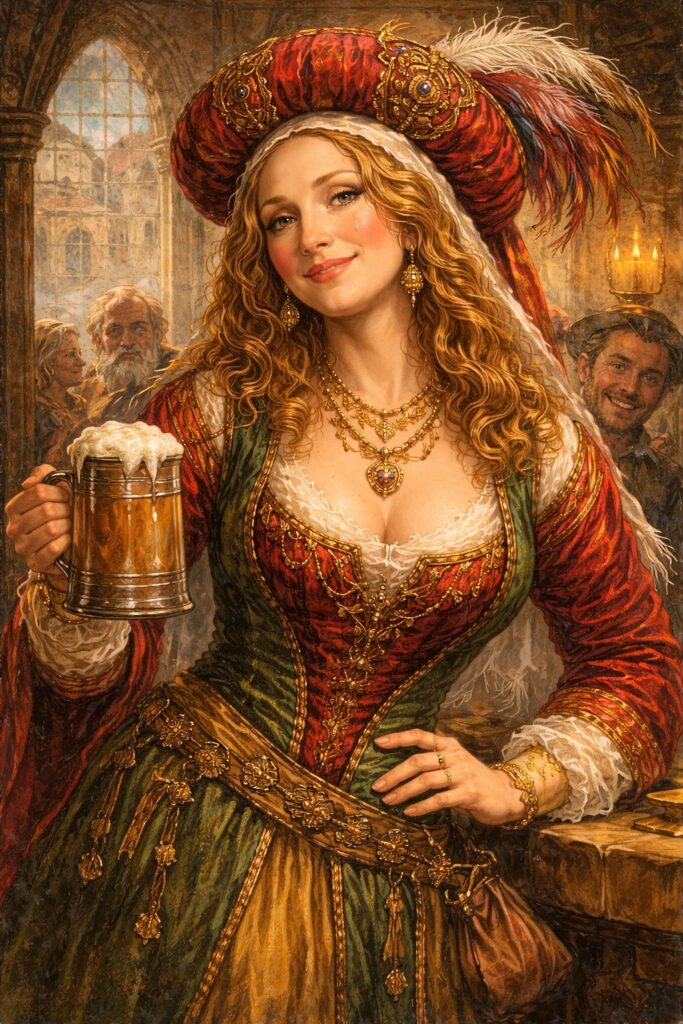
The Wife of Bath is one of Chaucer’s most memorable characters. Bold, confident, and outspoken, she has been married five times and speaks openly about marriage and women’s rights. She challenges traditional views of female submission and stands as a symbol of independence and experience.
The Parson
The Parson is the true example of Christian virtue. He practices what he preaches, living a humble and honest life. Unlike corrupt church figures, he genuinely cares for his people. Chaucer clearly admires him as a model of moral integrity.
The Plowman
The Plowman, brother of the Parson, is hardworking, kind, and honest. He represents the ideal common man loyal to God, family, and labor. Through him, Chaucer honors simple goodness and sincerity.
The Miller
The Miller is loud, strong, and fond of drinking. He enjoys telling rude jokes and bending rules. Chaucer presents him as a lively but morally questionable figure, adding humor and realism to the pilgrimage.
The Manciple
The Manciple works for lawyers but cleverly outsmarts them despite having little formal education. He is shrewd, practical, and street-smart, proving that intelligence comes in many forms.
The Reeve
The Reeve manages estates and is feared for his strict control. He is thin, secretive, and very skilled at making money for himself. Chaucer portrays him as clever but somewhat bitter, shaped by years of hard responsibility.
The Summoner
The Summoner works for the church court but is corrupt and dishonest. He accepts bribes and ignores justice. Chaucer exposes him as a symbol of moral decay within religious institutions.
The Pardoner
The Pardoner sells fake religious relics and openly admits his greed. Yet, his sermons against greed are powerful and persuasive. This contradiction makes him one of the most complex characters, a perfect example of hypocrisy mixed with brilliance.
The Canon
The Canon appears briefly but represents false science and deception. He pretends to practice alchemy but is actually a fraud. Chaucer uses him to warn against dishonesty disguised as knowledge.
The Canon’s Yeoman
The Canon’s Yeoman reveals the truth about his master’s tricks. Honest and tired of lies, he exposes the dangers of false promises and fake learning. Through him, Chaucer highlights the value of truth over illusion.
Why These Characters Matter
Together, these pilgrims form a complete picture of medieval society, from nobles to peasants, from saints to sinners. Chaucer does not judge harshly; instead, he observes human nature with humor, sympathy, and deep understanding.
The Canterbury Tales remains timeless because these characters still feel real today, full of ambition, weakness, virtue, and humor, just like people in every age.
Frequently Asked Questions (FAQ)
1. What is The Canterbury Tales about?
The Canterbury Tales is a collection of stories told by a group of pilgrims traveling to Canterbury. Each character shares a tale, revealing their personality, beliefs, and social background, making the work a rich portrait of medieval English society.
2. Why is Geoffrey Chaucer called the father of English literature?
Chaucer is known as the father of English literature because he popularized writing in Middle English instead of Latin or French. His work made literature accessible to common people and laid the foundation for modern English literature.
3. What is the significance of the General Prologue?
The General Prologue introduces all the pilgrims and gives vivid descriptions of their characters. It acts like a portrait gallery, showing people from different social classes and professions, making it one of the finest character studies in literature.
4. How many characters are there in The Canterbury Tales?
There are about 30 major pilgrims, including the narrator Chaucer himself. Each character represents a different section of medieval society: religious figures, nobles, tradesmen, and common folk.
5. What is the main theme of The Canterbury Tales?
The major themes include:
- Human nature and individuality
- Social class and hypocrisy
- Religion and morality
- Love, marriage, and power
- Humor, satire, and realism
Chaucer blends seriousness with comedy to reflect real life.
6. Why is The Canterbury Tales considered a secular work?
Although the journey is a religious pilgrimage, Chaucer focuses more on human behavior than religion. He presents people as they are flawed, funny, ambitious, and emotional, making the poem strongly secular in spirit.
7. Who is the most famous character in The Canterbury Tales?
Some of the most famous characters include:
- The Knight: symbol of honor and chivalry
- The Wife of Bath: a bold and independent woman
- The Pardoner: symbol of religious corruption
- The Monk: lover of luxury instead of discipline
Each character is memorable for their unique traits.
8. What role does the Host play in the story?
The Host, Harry Bailey, organizes the storytelling contest and acts as a guide and judge. He brings structure, humor, and leadership to the group, making the journey lively and engaging.
9. Why is the opening of The Canterbury Tales famous?
The poem begins with the iconic line:
“Whan that Aprill with his shoures soote…”
This beautiful description of spring symbolizes renewal, life, and the desire for journeys, setting the perfect mood for the pilgrimage.
10. Why is The Canterbury Tales still important today?
The Canterbury Tales remains relevant because it explores timeless human qualities: pride, greed, love, faith, and hypocrisy. Its characters feel real even after centuries, making it a masterpiece of storytelling and social observation.