
Every star you see in the night sky has a story. Some are young and energetic. Some are old and swollen. Some existed long before our Sun was even born. When we talk about Red Giant stars and the three great star populations of our universe, we are really talking about cosmic history. Who came first? Who shaped what? And how everything we know today grew out of those early beginnings.
This is the kind of story that makes you stop and look up at the sky with new eyes.
Today, we explore Red Giant Stars and the fascinating groups known as Population One, Population Two, and Population Three. By the end of this post, you will understand how the universe went from its first silent glow to the busy place we live in today.
The Journey of a Star and the Rise of the Red Giant Stars
Let us begin with something familiar, our Sun. One day, the Sun will swell to hundreds of times its current size. It will cool on the outside. It will glow with a deep orange color. And it will become a Red Giant Star.
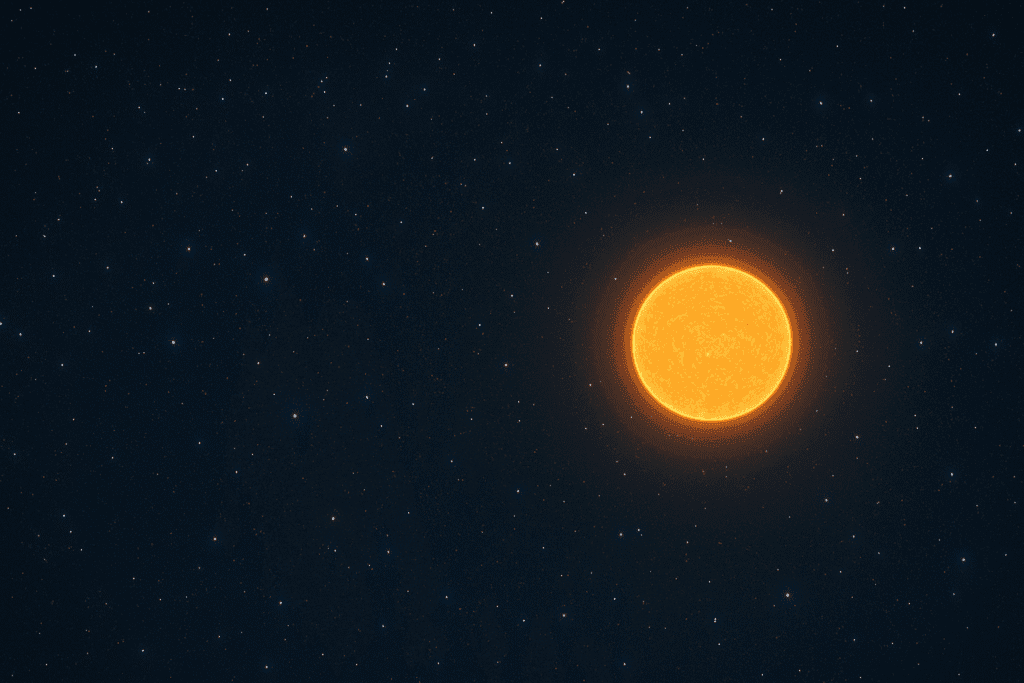
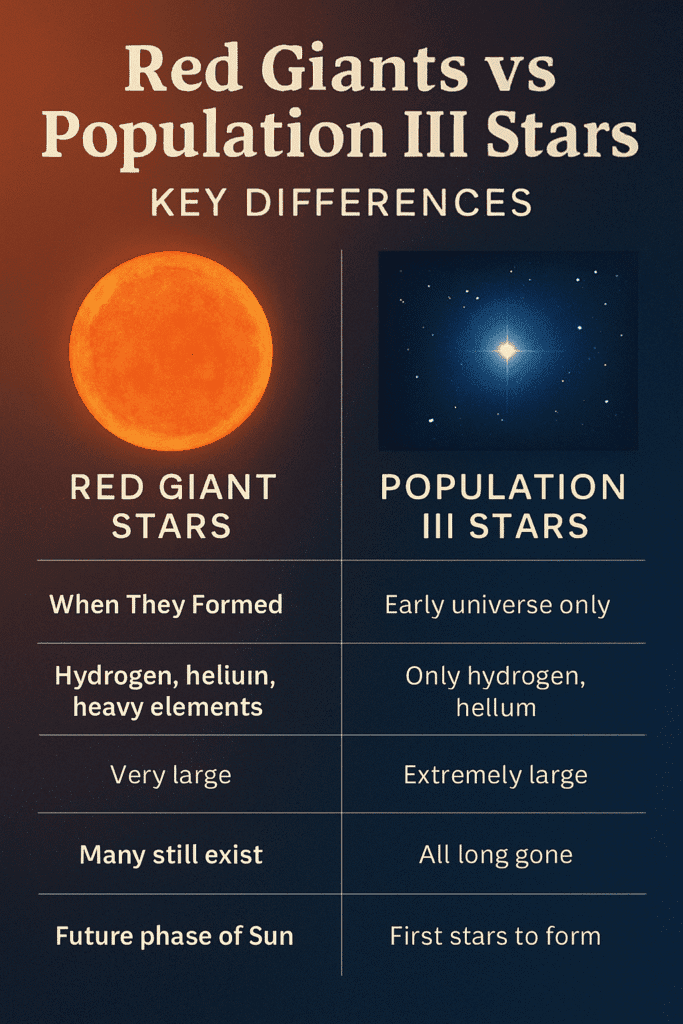
Red Giant Stars are aging stars that have burned most of the hydrogen fuel in their core. Without that fuel, the core contracts and heats up, while the outer layers expand. The result is a star that is huge and bright but cooler than before. It looks gentle, but it is a sign that the star is nearing the final chapters of its life.
Red Giant Stars are important because they enrich the universe with heavier elements when they die. Carbon, nitrogen, and other elements essential for life are produced inside them. Without Red Giant Stars, there would be no Earth and no living beings to study the sky.
But to understand how stars reach this stage, we must step further back into time. Because the universe did not always have stars like the ones we see today. In fact, the first stars were nothing like our Sun.
Population Three: The First Lights of Creation
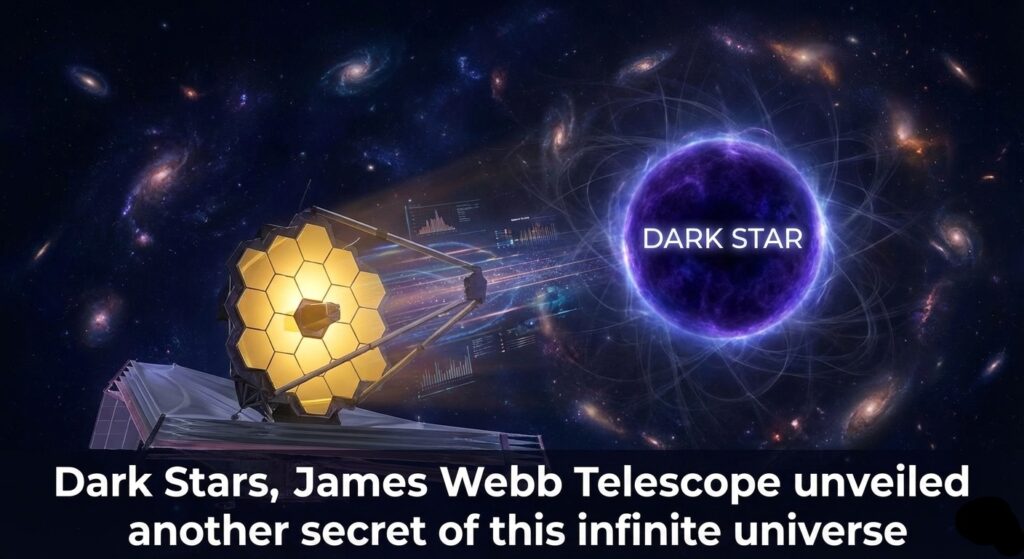
Population III stars were the very first stars that ever formed. They appeared a few hundred million years after the Big Bang, when the universe was dark and filled only with hydrogen and helium.
These stars were enormous and incredibly hot. Some were hundreds of times larger than the Sun. But they did not live long. They exploded quickly in violent supernovae that filled the young universe with heavier elements for the very first time.
Without Population III stars, nothing else would have been possible. Every planet, every galaxy, and every living creature owes its existence to the explosions of these ancient giants.
Not a single Population Three star survives today. They burned out billions of years ago. But their fingerprints are all around us in the form of the elements that build planets and life.
Population Two Stars: The Bridge Between the Ancient and the Modern
After the first stars enriched the universe with heavier elements, a second generation of stars was born. These are Population Two stars. They still contain very little metal but much more than the first generation.
Population Two stars live in the oldest parts of galaxies, like the halos and globular clusters. Many of them are extremely old and have been shining since the early days of the Milky Way.
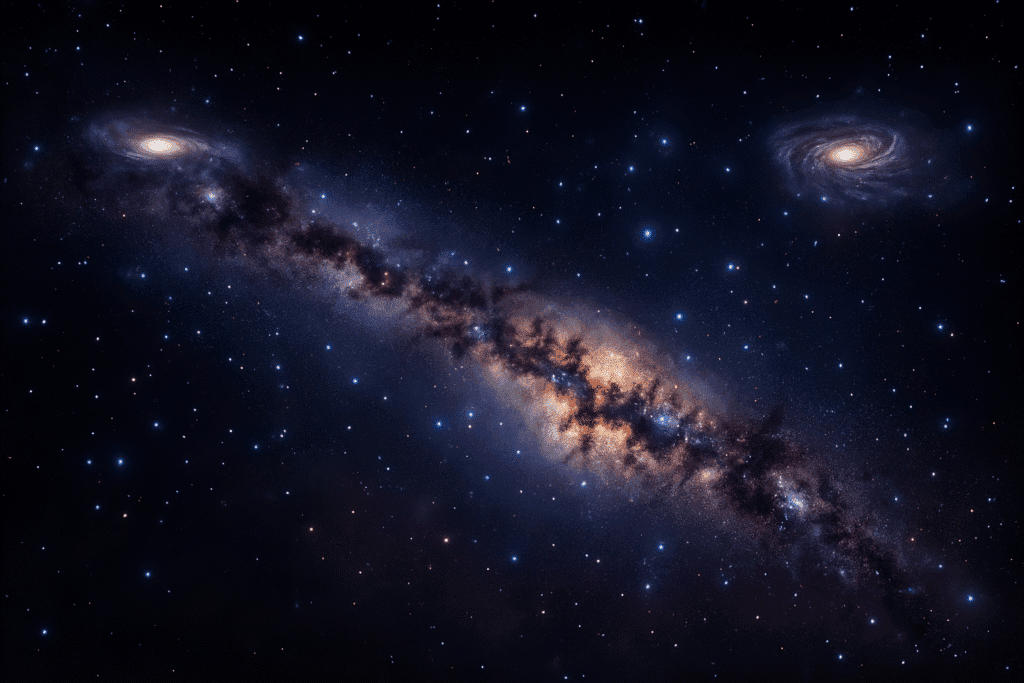
They are often smaller and longer-lived than the gigantic Population Three stars, which is why some still exist today.
These stars helped stabilize galaxies and provided the building material for the next and final generation.
Population One Stars: The Modern Stars Including Our Sun
Finally, we reach the stars we know well. Population One stars are the youngest group, and they contain the highest amounts of heavy elements. Our Sun is one of them.
These elements make it possible for planets to form. Without metals, there would be no rocky planets, asteroids, oceans, mountains, or life. The universe truly became interesting only after Population One stars entered the cosmic stage.
These stars reside in the spiral arms of galaxies and form the bright patterns visible in images of the Milky Way.
How It All Fits Together?
You can imagine the universe as a long story with three main chapters.
Population Three stars were the pioneers that lit the dark universe and created the first heavy elements.
Population Two stars were the builders that shaped early galaxies and added more richness to the cosmic environment.
Population One stars are the refined and modern generation that made planets and life possible.
Red Giant Stars can belong to any of these populations depending on their age. A Red Giant is simply a stage of a star’s life rather than a specific population. Our Sun will join this stage billions of years from now.
Why This Matters For Us?
Every breath you take contains atoms that were created inside ancient stars. The iron in your blood. The calcium in your bones. The oxygen in your lungs. Each of them was forged in a cosmic furnace long before Earth even existed.
When you look at Red Giant Stars today, you are looking at a factory that is shaping the future. When you look at old Population Two stars, you are seeing the earliest chapters of our galaxy. And when you learn about Population Three stars, you are standing at the edge of the universe, beginning.
Understanding these stars is like reading the universe’s autobiography.
FAQ
Q1: What are Red Giant stars?
A: Red Giant stars are aging stars that have used up most of the hydrogen fuel in their cores. As the core contracts and heats up, the outer layers expand and cool, giving the star a large size and reddish appearance. This phase marks the late stage of a star’s life cycle.
Q2: Will our Sun become a Red Giant star?
A: Yes. In about 5 billion years, the Sun will expand into a Red Giant after it runs out of hydrogen fuel. During this phase, it will grow much larger and brighter before eventually shedding its outer layers.
Q3: Why are Red Giant stars important to the universe?
A: Red Giant stars create and release essential elements like carbon, nitrogen, and oxygen into space. These elements are crucial for forming planets and life, making Red Giants key contributors to cosmic evolution.
Q4: What are stellar populations in astronomy?
A: Stellar populations are groups of stars classified by their age and chemical composition. Astronomers divide stars into three main groups: Population I, Population II, and Population III, each representing a different era in the universe’s history.
Q5: What were Population III stars?
A: Population III stars were the first stars ever formed after the Big Bang. They were massive, extremely hot, and composed almost entirely of hydrogen and helium. Although none exist today, they created the first heavy elements through powerful supernova explosions.
Q6: Why can’t we see Population III stars today?
A: Population III stars burned their fuel very quickly and exploded billions of years ago. Because of their short lifespans and extreme age, none have survived to the present day.
Q7: What are Population II stars?
A: Population II stars formed after Population III stars enriched the universe with heavier elements. They are old, metal-poor stars commonly found in globular clusters and the halos of galaxies. Many of them still exist today.
Q8: What are Population I stars?
A: Population I stars are the youngest stars and contain the highest amounts of heavy elements. They are found mainly in the spiral arms of galaxies. Our Sun is a Population I star, and these stars are most likely to host planetary systems.
Q9: Can Red Giant stars belong to any stellar population?
A: Yes. A Red Giant is a stage in a star’s life, not a population. Stars from Population I or II can become Red Giants as they age, depending on their mass and lifespan.
Q10: Why do stellar populations matter to life on Earth?
A: Every element in our bodies was created inside stars. The heavy elements necessary for planets and life were forged by earlier generations of stars. Understanding stellar populations helps us understand our own cosmic origins.
Q11: How do stellar populations tell the story of the universe?
A: Population III stars began the universe’s chemical evolution, Population II stars shaped early galaxies, and Population I stars enabled planets and life. Together, they form a timeline of cosmic history written in starlight.
Q12: What is the main takeaway from studying Red Giant stars and stellar populations?
A: Studying these stars reveals how the universe evolved from simple elements to complex systems capable of supporting life. It shows that everything around us, including ourselves, is connected to ancient stars.