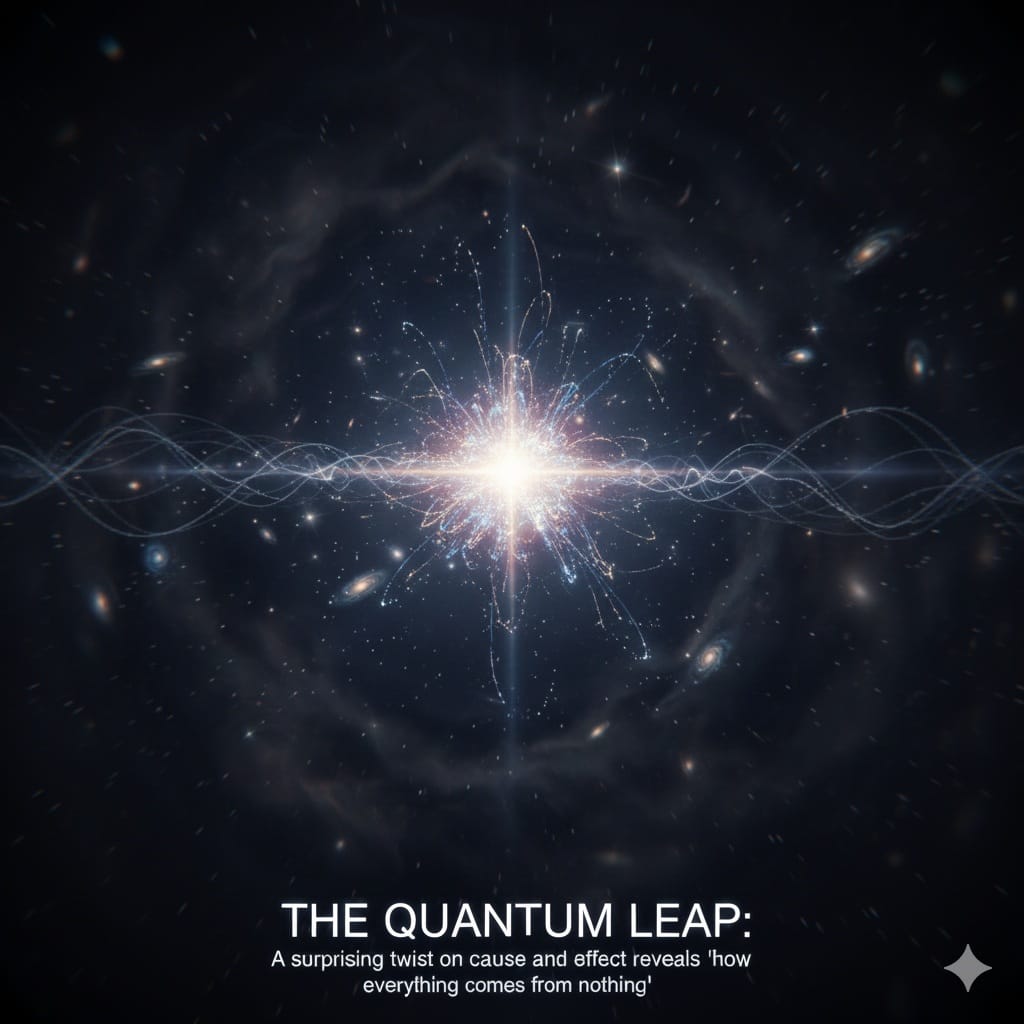
Have you ever wondered how something can emerge from nothing? It is a stunning story of cosmic creation. It sounds like the opening line of a fantasy novel or a mystical parable, but in the strange and wondrous world of quantum physics, this idea is very real and very puzzling. What scientists have uncovered over the past century challenges our deepest intuitions about reality, cause and effect, and the very origin of the cosmic itself. In this post, we’ll journey through the quantum realm to explore how the tiniest particles, particles so small that billions could fit across the width of a human hair, hint at a radical truth: everything may indeed come from nothing.
The Classical View: Cause and Effect, the Old-fashioned Way
For centuries, humans have understood the cosmic through the lens of cause and effect. Drop a stone, and it falls. Turn a key, and a lock opens. Heat water, and it boils. These straightforward chains of action and reaction form the backbone of classical physics, dating back to Newton. Everything seemed predictable. Every effect had a cause.
But then came the 20th century, and with it, a revolution that shook this comfortable worldview. The rules of the macroscopic world, the world of apples, planets, and billiard balls, did not apply when you zoomed down to the subatomic level. Here, reality behaves in ways that defy intuition and challenge the very notion of causality.
Enter the Quantum Realm
At the heart of this revolution lies quantum mechanics, the science of the very small. Quantum mechanics is famously counterintuitive. Particles can exist in multiple states at once (a phenomenon called superposition), they can be entangled across vast distances, and crucially for our discussion, they can appear seemingly from nowhere.
This last point is where the idea of “something from nothing” begins to make sense. In the quantum vacuum, the supposed emptiness of space, particles constantly pop in and out of existence. Physicists call these virtual particles, and they are a fundamental feature of reality.
But how can particles emerge from nothing? Isn’t the vacuum supposed to be empty? Here’s where the story gets truly fascinating.
The Quantum Vacuum: Not Empty at All
At first glance, a vacuum seems to be a void, utter nothingness. Yet quantum theory tells us that this nothingness is actually seething with energy. According to the famous Heisenberg Uncertainty Principle, even space cannot have precisely zero energy. This “quantum jitter” allows particle-antiparticle pairs to spontaneously form and annihilate each other in the blink of an eye.
Imagine the cosmic as a restless ocean. From the surface, it looks calm, even empty. But beneath the surface, waves are constantly forming and collapsing, creating patterns that are invisible to the casual observer. In the same way, the quantum vacuum is never truly empty; it’s a dynamic, bubbling field where the seeds of reality may sprout.
How “Nothing” Becomes “Something”
So how does this quantum froth give rise to the tangible cosmic we inhabit? Here’s a simplified picture. If the quantum vacuum is like a restless ocean, then fluctuations in this ocean can sometimes be amplified. Tiny quantum events, magnified by cosmic processes like inflation (the rapid expansion of the universe in its earliest moments), can grow into the large-scale structures we see today, galaxies, stars, planets, and eventually life itself.
In other words, the cosmos may have started from a state that was effectively “nothing” in the classical sense, yet it was a fertile nothing, a quantum nothing, capable of generating everything we observe.
This idea isn’t just speculation. Theoretical physicists like Edward Tryon in the 1970s proposed that the universe itself could be a quantum fluctuation. Modern cosmology has refined this idea further. Some theories even suggest that our universe is just one of many “bubble universes” emerging from an underlying quantum field, a concept known as the multiverse.
Rethinking Cause and Effect
All of this forces us to rethink one of our most basic assumptions: that every effect must have a cause. In the quantum world, causality becomes fuzzy. An electron doesn’t always follow a predictable path; it behaves probabilistically. Actions at one point can influence events at a distant point instantly through quantum entanglement. And the very existence of this infinite universe itself may have no classical cause at all, just the natural unfolding of quantum laws.
This isn’t to say that “anything goes” or that science breaks down. On the contrary, the quantum world is governed by extremely precise mathematical rules. But these rules allow for phenomena that our everyday intuition would classify as impossible.
Implications for Science and Philosophy
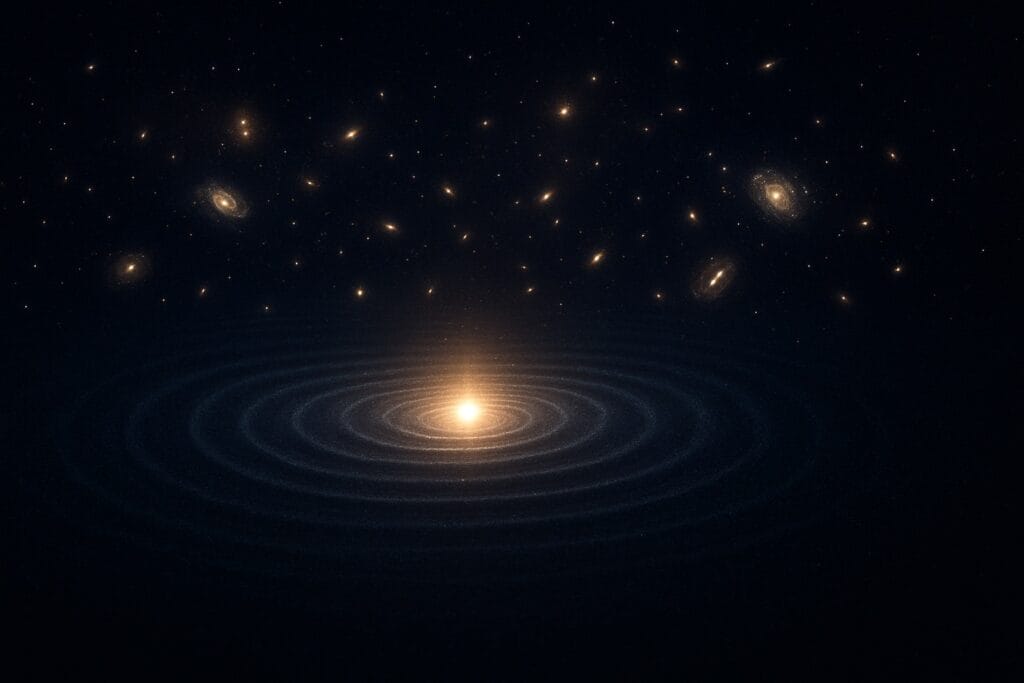
The idea that everything can emerge from nothing has profound implications. Philosophically, it challenges the notion of creation ex nihilo (creation out of nothing) that has been a cornerstone of religious and metaphysical thought. Scientifically, it opens new pathways to understanding the origin of cosmic, its evolution, and even the nature of reality itself.
Consider energy conservation. In classical physics, energy can neither be created nor destroyed. Yet in quantum mechanics, energy can temporarily “borrow” from the vacuum, as long as it is repaid quickly, a loophole that allows for spontaneous particle creation. This subtle twist shows how quantum rules differ from classical ones in ways that are small on the subatomic scale but immense in cosmic consequences.
Moreover, this quantum perspective offers hope for unifying two pillars of physics: general relativity and quantum mechanics. The former governs the large-scale structure of spacetime, while the latter rules the microscopic realm. Understanding how universes emerge from quantum fluctuations could be the key to a theory of quantum gravity, a holy grail of modern physics.
The Beauty of the Unknown
Perhaps the most enchanting lesson of the quantum world is its reminder of mystery. Science is often portrayed as a relentless quest for certainty, but quantum physics teaches us that uncertainty is fundamental. It invites awe and humility, revealing that the universe is far stranger and more wondrous than our everyday experiences suggest.
In this strange, invisible realm, “nothing” is alive with possibility, and “something” is just the beginning of an endless cosmic story. The quantum leap from nothing to everything challenges not only our scientific understanding but also our imagination, asking us to expand the very way we think about reality.
Conclusion: Embracing the Quantum Perspective
So, how does everything come from nothing? The answer lies in the quantum fabric of reality, a world where emptiness teems with energy, where particles dance in and out of existence, and where the classical rules of cause and effect are rewritten.
The universe, it seems, is both miraculous and natural. It emerges not by breaking the laws of physics but by obeying them in ways that defy our everyday intuition. By peering into the quantum realm, we are offered a glimpse of the profound interconnectedness of existence, the hidden processes that shape our cosmos, and the astonishing truth that “nothing” is never truly empty.
In the end, the quantum leap is more than a scientific concept; it is a celebration of curiosity, a reminder that reality is stranger, deeper, and more inspiring than we could ever imagine. And as we continue to explore the universe, who knows what other surprises await? One thing is certain: the journey from nothing to everything is far from over.
Frequently Asked Questions (FAQ)
What does “everything comes from nothing” mean in quantum physics?
In quantum physics, “nothing” does not mean absolute emptiness. It refers to the quantum vacuum, which appears empty but is actually full of energy fluctuations. These fluctuations allow particles to briefly appear and disappear, making it possible for “something” to arise from what seems like nothing.
Is the quantum vacuum really empty space?
No. The quantum vacuum is not empty in the classical sense. It is a dynamic field filled with temporary particles and energy changes caused by the uncertainty principle. This hidden activity makes the vacuum a potential source of matter and energy.
How can particles appear from nothing?
According to quantum mechanics, particles can emerge due to quantum fluctuations. These fluctuations occur because nature does not allow perfectly still energy states. As a result, particle–antiparticle pairs can briefly come into existence before disappearing again.
Does this idea break the law of cause and effect?
Not exactly. Quantum physics does not eliminate cause and effect, but it changes how causality works. Events are no longer strictly predictable; instead, they follow probabilities. Effects can occur without a clear classical cause, but they still follow precise quantum laws.
What is the role of the uncertainty principle in this process?
The Heisenberg Uncertainty Principle allows energy to fluctuate for short periods of time. This principle makes it possible for particles to appear temporarily from the vacuum, laying the foundation for the idea that something can emerge from nothing.
Could the universe itself have come from a quantum fluctuation?
Some physicists believe so. Certain cosmological theories suggest that the universe may have begun as a quantum fluctuation in a larger quantum field. While still theoretical, this idea fits well with modern models of cosmology and inflation.
Does quantum physics support the idea of a multiverse?
Some interpretations of quantum mechanics and cosmology suggest that multiple universes may exist. These “bubble universes” could form from quantum processes, though this remains a fascinating hypothesis rather than a proven fact.
Is this concept scientific or philosophical?
It is both. Scientifically, it is grounded in quantum mechanics and cosmology. Philosophically, it raises deep questions about existence, creation, and the nature of reality. This blend of science and philosophy is what makes the topic so powerful and intriguing.
Does quantum theory mean that reality is random?
Quantum theory introduces fundamental uncertainty, but not chaos. Events follow strict mathematical rules, even though their exact outcomes cannot always be predicted. Reality is not random; it is probabilistic.
Why is this idea so hard to understand?
Human intuition is shaped by everyday experiences in a classical world. Quantum physics operates at scales far beyond direct experience, where common ideas like solid objects, fixed paths, and simple causes no longer apply. This makes the concept challenging but also deeply fascinating.
How does this idea affect our understanding of the universe?
It transforms our view of reality. Instead of seeing the universe as a rigid machine, quantum physics reveals a dynamic, creative cosmos, where possibility is woven into the fabric of existence itself.