
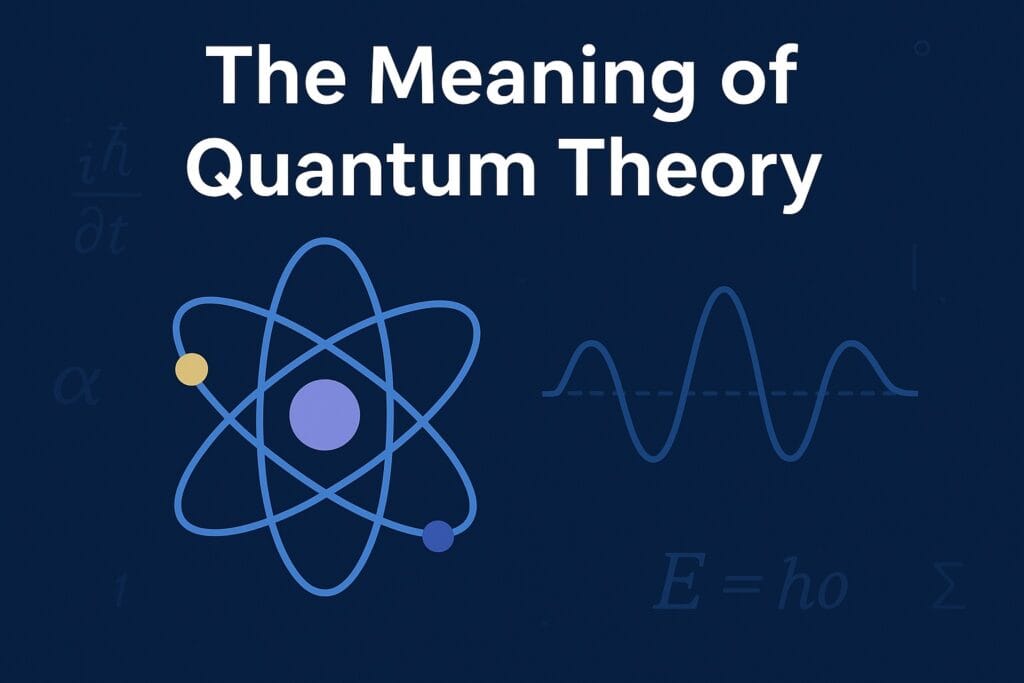
Quantum theory is one of the most powerful and successful scientific frameworks ever developed, yet it is also one of the most misunderstood. It governs the behavior of matter and energy at the smallest scales of reality, far beyond what our senses can perceive. While classical physics explains the motion of planets, falling apples, and flowing rivers, quantum theory explains atoms, electrons, photons, and the fundamental structure of the universe itself.
For many readers, quantum theory feels mysterious, abstract, and even philosophical. Terms like wave function, uncertainty, superposition, and probability often sound confusing. This confusion is natural because quantum theory challenges the way humans intuitively understand reality. However, when studied carefully, its meaning becomes clearer and deeply fascinating.
This article explores the meaning of quantum theory in a clear and accessible way. We will examine why it was needed, what it tells us about nature, how scientists interpret it, and why it matters not only to physics but also to technology and human understanding.
Why Quantum Theory Was Needed
At the end of the nineteenth century, scientists believed that physics was nearly complete. Classical mechanics, developed by Newton, explained motion, and Maxwell’s equations explained electricity and magnetism. The universe appeared predictable and deterministic, like a perfectly running machine.
However, several experiments produced results that classical physics could not explain. One famous example was blackbody radiation. According to classical theory, a heated object should emit infinite energy at short wavelengths, which was clearly impossible. Another problem involved the photoelectric effect, where light striking a metal surface released electrons in a way that contradicted classical expectations.
To solve these problems, physicists were forced to abandon some long-held assumptions. In 1900, Max Planck introduced the idea that energy is emitted in discrete packets, which he called quanta. This was the birth of quantum theory. Later, Albert Einstein, Niels Bohr, Louis de Broglie, Werner Heisenberg, and Erwin Schrödinger expanded these ideas into a full theoretical framework.
Quantum theory was not created to be strange or philosophical. It emerged because nature itself behaved in ways that classical physics could not describe.
The Core Idea of Quantum Theory

At its heart, quantum theory tells us that the microscopic world does not behave like the macroscopic world we experience daily. Particles at the quantum level do not have definite positions and velocities at all times. Instead, their behavior is governed by probabilities.
One of the central concepts is the wave function. The wave function does not describe a particle as a tiny solid object moving through space. Instead, it describes a range of possible outcomes and the likelihood of each one. When a measurement is made, one of these possibilities becomes actual.
This does not mean that reality is imaginary or unreal. It means that at fundamental levels, nature does not commit to a single outcome until an interaction or observation occurs. This idea is deeply counterintuitive, but it has been confirmed by countless experiments.
Wave Particle Duality
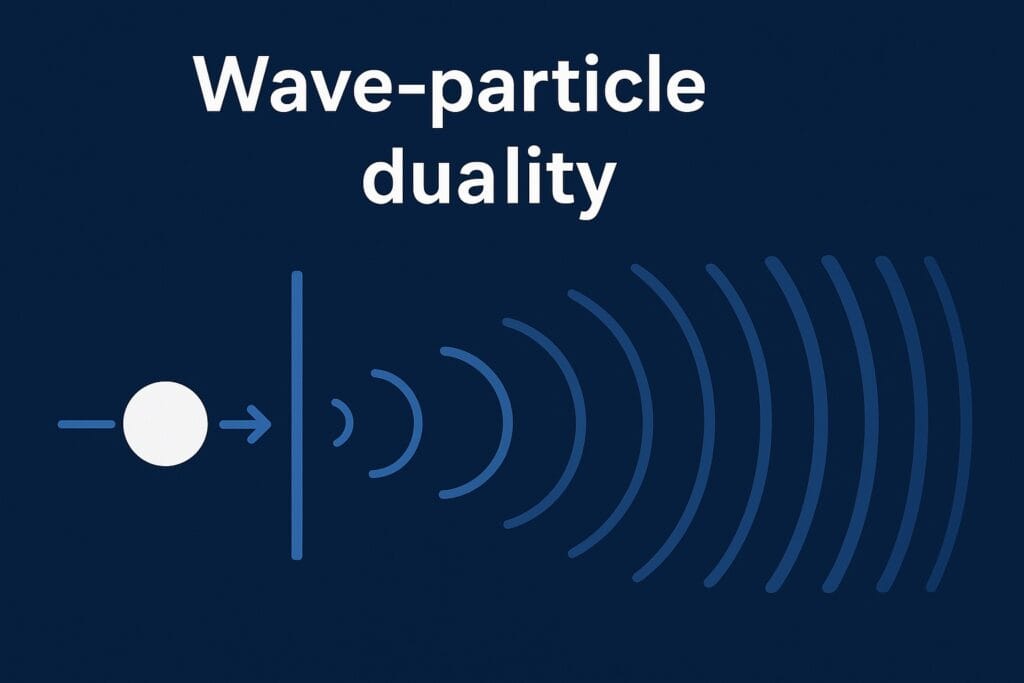
One of the most famous ideas in quantum theory is wave-particle duality. Experiments show that particles like electrons and photons sometimes behave like particles and sometimes like waves.
In the double slit experiment, particles fired one at a time through two slits produce an interference pattern, a behavior associated with waves. However, when scientists try to observe which slit the particle passes through, the interference pattern disappears, and the particles behave like classical objects.
The meaning of this phenomenon is not that particles magically change their nature. Instead, it shows that classical categories like wave and particle are incomplete descriptions of quantum objects. Quantum entities are neither purely waves nor purely particles. They are something more fundamental that displays different aspects depending on how they are measured.
The Role of Probability
Classical physics is deterministic. If you know the initial conditions of a system, you can predict its future behavior exactly. Quantum theory replaces this certainty with probability.
For example, quantum theory does not tell us the exact moment when a radioactive atom will decay. It only gives the probability that it will decay within a certain time. This randomness is not due to ignorance or lack of information. It is an intrinsic feature of nature.
This aspect of quantum theory has led to deep philosophical debates. Some scientists were uncomfortable with the idea that nature at its core is probabilistic. Einstein famously said that he did not believe God plays dice with the universe. Yet every experiment performed so far supports the probabilistic predictions of quantum theory.
The Uncertainty Principle
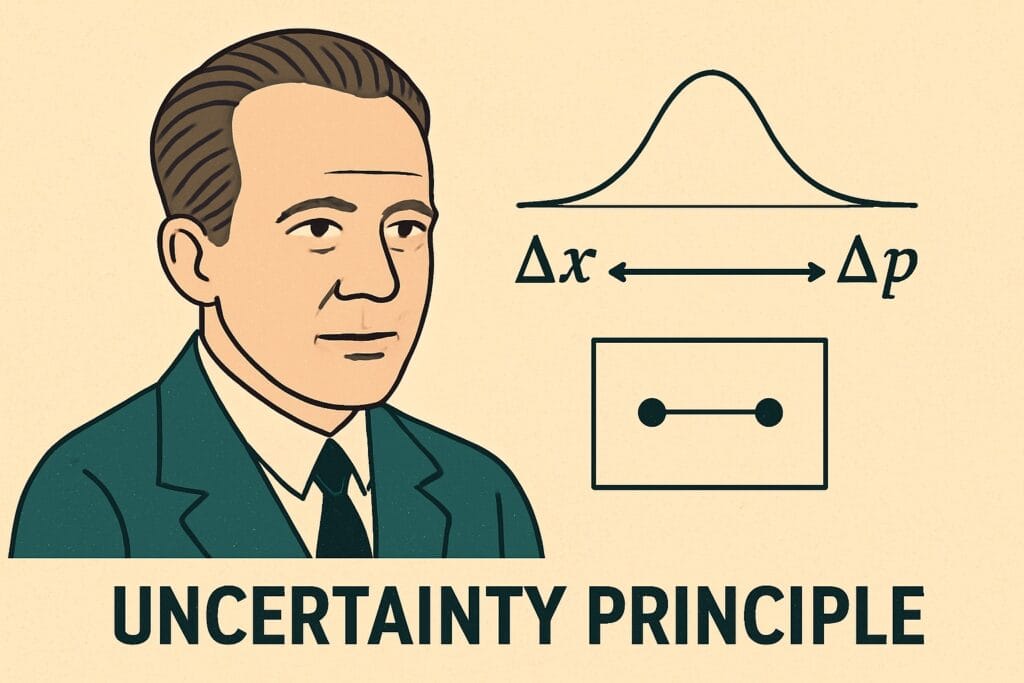
The Heisenberg uncertainty principle is another key part of quantum theory. It states that certain pairs of physical properties cannot be known with perfect precision at the same time. The most famous example is position and momentum.
This does not mean that our measuring instruments are flawed. It means that the very nature of quantum objects prevents exact simultaneous knowledge of these properties. The more precisely we measure a particle’s position, the less precisely we can know its momentum, and vice versa.
The meaning of the uncertainty principle is often misunderstood. It does not suggest chaos or lack of order. Instead, it reveals a fundamental limit to how nature can be described. It tells us that reality is not made of tiny billiard balls following precise trajectories.
Measurement and Reality
One of the most debated aspects of quantum theory is the measurement problem. According to the mathematical formalism, a quantum system exists in a superposition of possible states. When a measurement occurs, the system appears to collapse into a single outcome.
What exactly causes this collapse is still an open question. Different interpretations of quantum theory attempt to explain it in different ways. Some suggest that measurement involves interaction with the environment. Others propose that all possible outcomes occur in separate branches of reality.
Despite these debates, the practical predictions of quantum theory remain accurate. Engineers and scientists use quantum principles daily without needing to resolve these philosophical questions.
Interpretations of Quantum Theory
Quantum theory has several interpretations, each offering a different perspective on its meaning. It is important to note that these interpretations do not change the mathematical predictions. They change how we think about what the theory says about reality.
The Copenhagen interpretation suggests that quantum properties do not exist until measured. Reality is fundamentally linked to observation.
The many-worlds interpretation proposes that every possible outcome of a quantum event actually occurs in separate, branching universes.
The pilot wave theory suggests that particles have definite positions guided by a wave, restoring determinism at a deeper level.
Each interpretation has strengths and weaknesses, and none has been conclusively proven correct. This diversity reflects the depth and complexity of quantum theory.
Quantum Theory and Technology

The meaning of quantum theory is not limited to abstract philosophy. It has practical consequences that shape modern life. Technologies such as transistors, lasers, semiconductors, and magnetic resonance imaging rely directly on quantum principles.
Computers, smartphones, solar panels, and medical devices all depend on quantum mechanics. Emerging technologies like quantum computing and quantum cryptography promise to revolutionize information processing and security.
These applications demonstrate that quantum theory is not merely a theoretical curiosity. It is a practical and reliable description of nature.
Quantum Theory and Our View of Reality
Perhaps the most profound meaning of quantum theory lies in how it changes our understanding of reality. It teaches us that the universe is not as simple or as intuitive as it appears.
Quantum theory challenges the idea that objects have definite properties independent of observation. It suggests that relationships, interactions, and probabilities play a fundamental role in shaping reality.
This does not reduce reality to illusion. Instead, it expands our understanding beyond classical limitations. Just as Newtonian physics was once revolutionary, quantum theory represents a deeper layer of truth about the universe.
Common Misconceptions About Quantum Theory
Quantum theory is often misused in popular culture and pseudoscience. Claims that human thoughts directly control reality or that quantum physics proves mystical beliefs are not supported by scientific evidence.
While quantum theory does involve observation, this does not mean consciousness magically alters the universe. Measurements in physics can be performed by machines with no awareness.
Understanding the true meaning of quantum theory requires careful study, not exaggeration or speculation. Respecting its scientific foundations is essential.
Why Quantum Theory Is Difficult to Understand

Quantum theory is difficult because it does not align with everyday experience. Human intuition evolved to deal with large objects moving at slow speeds, not with particles existing in superpositions.
Mathematics plays a central role in quantum theory, and its concepts are often expressed through equations rather than words. This makes it challenging to explain in simple language.
However, difficulty does not mean impossibility. With patience and clear explanations, the core ideas of quantum theory can be understood at a conceptual level by anyone interested in learning.
The Future of Quantum Theory
Quantum theory continues to evolve. Researchers are exploring the connection between quantum mechanics and gravity, seeking a unified theory of nature. Experiments are testing quantum behavior at increasingly larger scales.
As our understanding deepens, new technologies and insights will emerge. Quantum theory remains an active and vibrant field of scientific inquiry.
Conclusion
The meaning of quantum theory goes far beyond equations and experiments. It represents a fundamental shift in how humans understand the universe. It shows that reality at its deepest level is governed by probabilities, relationships, and limits to certainty.
Quantum theory does not deny the reality we experience. Instead, it reveals a richer and more complex foundation beneath it. By embracing its lessons, science has unlocked technologies that define modern civilization and opened doors to deeper philosophical questions.
Understanding quantum theory is not about memorizing formulas. It is about appreciating how nature truly works when we look beyond appearances. In this sense, quantum theory is not just a scientific achievement. It is a profound intellectual journey that continues to inspire curiosity and wonder.
Frequently Asked Questions (FAQs)
Q1: What is quantum theory in simple words?
A: Quantum theory is the branch of physics that explains how matter and energy behave at extremely small scales, such as atoms and subatomic particles. Unlike classical physics, it shows that nature works through probabilities rather than certainty.
Q2: Why was quantum theory needed?
A: Classical physics failed to explain several experiments, such as blackbody radiation and the photoelectric effect. Quantum theory was developed to solve these problems and accurately describe how light and matter behave at the microscopic level.
Q3: What does quantum theory really mean?
A: The meaning of quantum theory lies in its message that reality is not as fixed and predictable as we once thought. At the deepest level, nature operates through possibilities, uncertainty, and interaction rather than exact outcomes.
Q4: What is wave–particle duality?
A: Wave–particle duality means that tiny particles like electrons and photons can behave both as waves and as particles, depending on how they are observed. This shows that classical categories are not enough to describe quantum objects.
Q5: Why does quantum theory use probability instead of certainty?
A: At the quantum level, nature does not follow strict cause-and-effect rules. Instead, it works through probability. For example, we cannot predict exactly when an atom will decay, only the chance that it will.
Q6: What is the uncertainty principle?
A: The Heisenberg uncertainty principle states that we cannot know certain pairs of properties, like a particle’s position and momentum, at the same time with perfect accuracy. This is not a limitation of tools; it is a fundamental law of nature.
Q7: What happens during measurement in quantum theory?
A: Before measurement, a quantum system exists in many possible states at once. When we measure it, one outcome becomes real. This process is known as the collapse of the wave function, and it remains one of the deepest mysteries in physics.
Q8: What are the main interpretations of quantum theory?
A: Some well-known interpretations include:
- Copenhagen interpretation: Reality becomes definite only when observed.
- Many-worlds interpretation: All outcomes happen in separate universes.
- Pilot-wave theory: Particles have definite paths guided by waves.
Each explains the same science but offers a different view of reality.
Q9: How does quantum theory affect everyday life?
A: Many modern technologies depend on quantum theory, including:
- Computers and smartphones
- Lasers and LED lights
- MRI scanners
- Solar panels
Without quantum theory, modern technology would not exist.
Q10: Is quantum theory just philosophy or real science?
A: Quantum theory is solid science, tested by thousands of experiments. While it raises deep philosophical questions, its predictions are extremely accurate and form the foundation of modern physics and technology.
Q11: Does quantum theory prove mystical or supernatural ideas?
A: No. Quantum theory is often misused in pseudoscience. While it involves observation and probability, it does not support claims that thoughts directly control reality. Its principles are scientific, not mystical.
Q12: Why is quantum theory so difficult to understand?
A: Because human intuition evolved for the everyday world, not for particles smaller than atoms. Quantum behavior feels strange because it does not match daily experience, and its ideas are expressed mainly through mathematics.
Q13: What is the future of quantum theory?
A: Scientists are working on:
- Quantum computing
- Quantum cryptography
- A unified theory combining quantum physics and gravity
Quantum theory continues to shape the future of science and technology.
Q14: Why is quantum theory important beyond physics?
A: Quantum theory changes how we think about reality, knowledge, and certainty. It shows that the universe is deeper, richer, and more mysterious than classical ideas ever imagined.