
Learning English grammar can be challenging, especially for non-native speakers. Even advanced learners often repeat common English Grammar Mistakes without realizing it. Understanding these errors is the first step toward speaking and writing English with confidence and accuracy.
Below are the most frequent English Grammar Mistakes learners make, along with clear explanations and correct examples.
1. Using the Wrong Verb Tense is One of the main English Grammar Mistakes
Many learners confuse past, present, and future tenses, especially when speaking quickly.
Incorrect:
I go to school yesterday.
Correct:
I went to school yesterday.
Tip: Always look for time expressions such as yesterday, now, tomorrow, or last year before choosing a tense.
2. Confusing “He” and “She”
This mistake is common in English Grammar Mistakes when a learner’s native language does not distinguish gender in pronouns.
Incorrect:
My sister said he is busy.
Correct:
My sister said she is busy.
3. Forgetting Articles (a, an, the)
Articles are small words, but they carry important meaning.
Incorrect:
She bought book.
Correct:
She bought a book.
Basic Rule:
- Use a / an for something non-specific
- Use the for something specific or already known
4. Overusing the Present Continuous Tense
Some learners use the continuous form with verbs that normally do not take it.
Incorrect:
I am knowing the answer.
Correct:
I know the answer.
❗ Verbs like know, believe, like, understand, and own are state verbs and are usually not used in continuous form.
5. Subject-Verb Agreement Errors

The verb must agree with the subject in number.
Incorrect:
She don’t like coffee.
Correct:
She doesn’t like coffee.
Reminder: Singular subjects require singular verbs.
6. Incorrect Use of Prepositions
Prepositions often follow usage patterns rather than clear rules.
Incorrect:
She is good in math.
Correct:
She is good at math.
Prepositions must be learned through reading, listening, and practice.
7. Using Double Negatives
In English, two negatives cancel each other and create confusion.
Incorrect:
I don’t need no help.
Correct:
I don’t need any help.
8. Confusing “Much” and “Many”
- Much → uncountable nouns (water, time, money)
- Many → countable nouns (books, students, ideas)
9. Capitalization Mistakes
Capital letters are essential for clarity and correctness.
Incorrect:
i live in pakistan.
Correct:
I live in Pakistan.
10. Incorrect Word Order
English sentence structure follows a clear pattern.
Incorrect:
She only not likes tea.
Correct:
She does not like tea.
Advanced English Grammar Mistakes Even Confident Learners Make
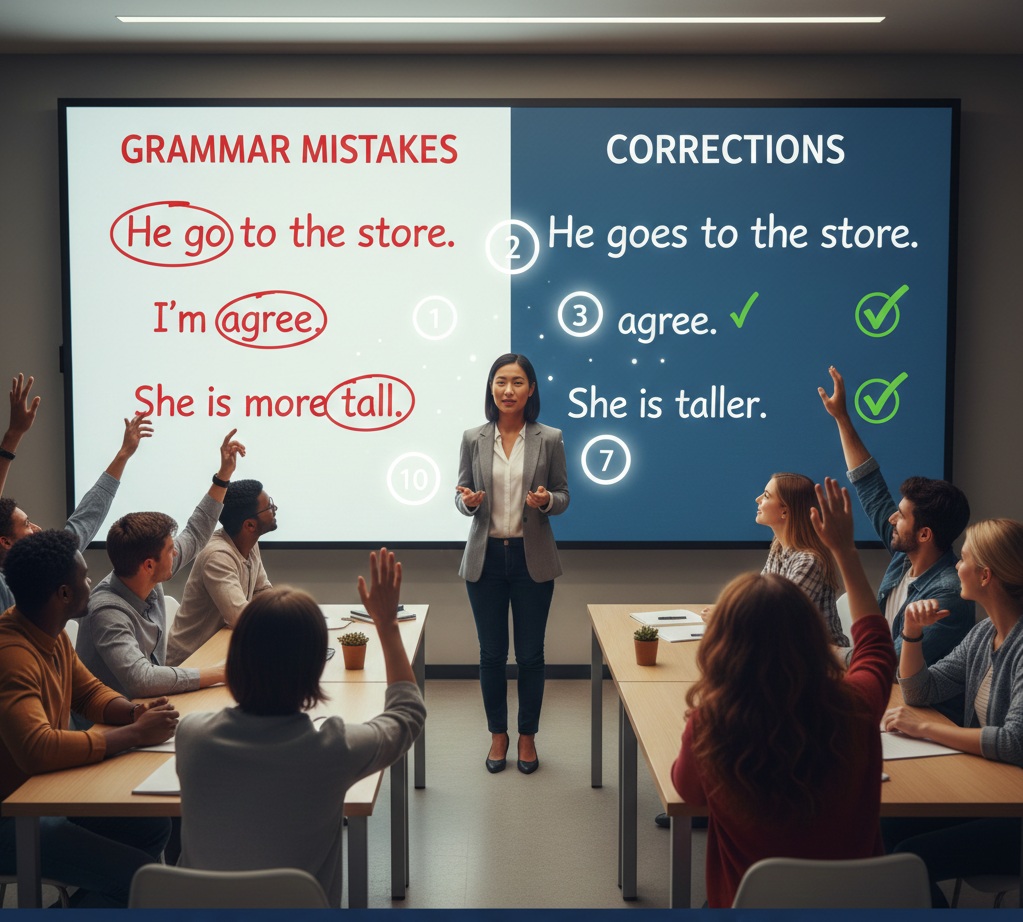
Even learners with strong grammar skills can make advanced mistakes. Avoiding these errors greatly improves academic and professional English.
11. Misusing Gerunds and Infinitives is one of the Common English Grammar Mistakes
Choosing between verb + ing and to + verb can be confusing.
Incorrect:
She suggested to go early.
Correct:
She suggested going early.
Some verbs (suggest, enjoy, avoid) are followed by gerunds, while others (decide, hope, plan) take infinitives. This distinction is based on usage, not logic.
12. Errors in Conditional Sentences
Conditionals follow strict tense patterns.
Incorrect:
If I will see him, I will tell him.
Correct:
If I see him, I will tell him.
Even advanced learners often mix these structures unconsciously.
13. Faulty Parallel Structure
Items in a list must follow the same grammatical pattern.
Incorrect:
She likes reading, to swim, and jogging.
Correct:
She likes reading, swimming, and jogging.
Parallel structure is especially important in formal writing and examinations.
14. Register Errors (Formal vs Informal English)
Using informal language in formal contexts reduces credibility.
Incorrect (formal email):
Hey, I wanna know about the meeting.
Correct:
I would like to inquire about the meeting.
Choosing the right level of formality is a strong sign of advanced language control.
Why These Mistakes Matter
Avoiding both basic and advanced English Grammar Mistakes helps learners communicate clearly, professionally, and confidently, especially in academic, workplace, and international settings.
Final Thoughts
English Grammar Mistakes are a natural part of learning English. The key is to notice them, understand them, and correct them through regular practice. With consistency and awareness, your accuracy and confidence will steadily improve.