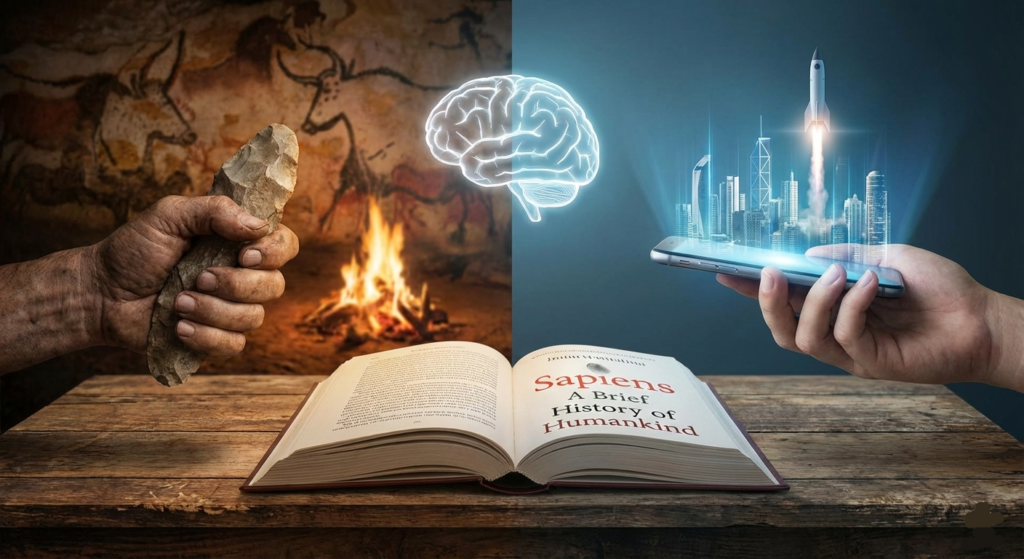
How did humans go from hunting animals with stone tools to building skyscrapers, artificial intelligence, and space rockets?
Why do billions of people believe in money, countries, laws, and religions, even though none of these exist physically in nature?
Why is Homo sapiens the most powerful species on Earth?
These questions are explored in one of the most influential books of modern times:
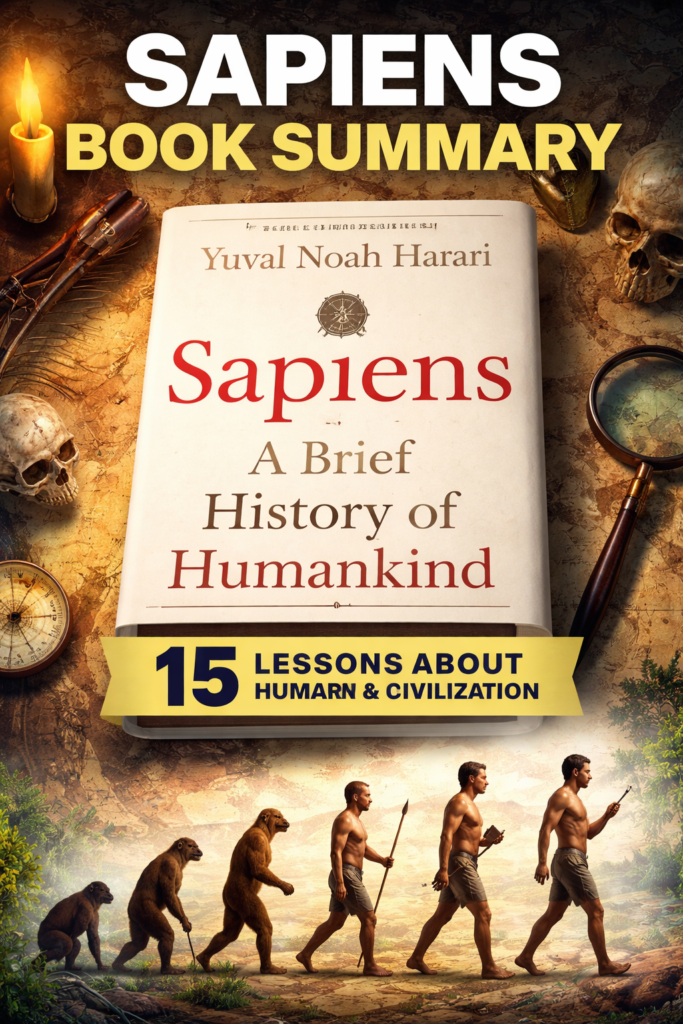
Sapiens: A Brief History of Humankind by Yuval Noah Harari.
This is not just a history book. It is a mind-opening journey that explains:
- The rise of human civilization
- The power of belief systems
- The origin of inequality
- The role of science and capitalism
- The future of humanity
This book helps readers understand who we are, how we got here, and where we are going.
About the Author

Yuval Noah Harari is a historian and professor known for simplifying complex historical and philosophical ideas. His writing style is clear, engaging, and thought-provoking, making Sapiens one of the most recommended books for students and curious readers worldwide.
Overview of Sapiens
The book divides human history into four major revolutions:
- The Cognitive Revolution
- The Agricultural Revolution
- The Unification of Humankind
- The Scientific Revolution
Each of these transformed the way humans lived and shaped modern society.
1. The Cognitive Revolution, The Real Beginning of Human Power

Around 70,000 years ago, something extraordinary happened. Humans developed advanced language and imagination. This changed everything.
Why Language Made Humans Powerful
Animals communicate, but human language became unique because it allowed us to:
- Share complex information
- Plan for the future
- Create cooperation among large groups
- Tell stories and myths
The Power of Fiction
Harari introduces one of the most important ideas of the book:
Humans rule the world because they can believe in shared myths.
Examples of shared myths:
- Money
- Nations
- Human rights
- Corporations
- Laws
These exist only in our collective imagination, yet they control our lives.
This ability allowed thousands, even millions, of strangers to cooperate. No other species can do this.
2. The Agricultural Revolution: The Biggest Mistake in History?
Around 12,000 years ago, humans began farming. Traditionally, this is seen as progress. But Harari offers a shocking view.
Why Farming Was Not All Good
Farming caused:
- Harder physical labor
- Poorer diet
- Disease spread
- Social inequality
- Population explosion
Humans worked more but did not necessarily become happier.
Harari famously says:
Wheat domesticated humans, not the other way around.
People began living in one place, raising crops and animals, instead of living freely as hunter-gatherers.
3. The Rise of Social Hierarchies
Agriculture led to cities, kingdoms, and empires. With these came inequality.
Societies divided people based on:
- Wealth
- Class
- Gender
- Power
Harari explains that many of these hierarchies are imagined orders, social systems that exist only because people believe in them.
4. The Unification of Humankind
Despite cultural differences, humans gradually united through three universal systems:
A. Money
Money is one of the greatest inventions in history. It works because everyone trusts it.
Money:
- Connects strangers
- Allows trade across cultures
- Creates global markets
Money is the most successful shared belief ever created.
B. Empires
Empires spread ideas, languages, and cultures across regions. Although often violent, they helped shape modern global society.
C. Religions
Religions gave moral systems and unity to large populations. They created order, meaning, and identity.
5. The Scientific Revolution, Knowledge Becomes Power
About 500 years ago, humans admitted something revolutionary:
“We don’t know everything.”
This admission led to:
- Modern science
- Technological inventions
- Medicine
- Industrial growth
Scientific curiosity changed human destiny.

6. Capitalism and Economic Growth
Harari explains how belief in future growth shaped modern economies. People trust that tomorrow will be better, which allows investment and development.
Capitalism has lifted millions out of poverty, but also created environmental challenges and inequality.
7. The Industrial Revolution and Modern Life
Machines replaced manual labor. Life became faster and more comfortable.
But this progress also brought:
- Stress
- Urban crowding
- Environmental damage
Modern life is easier physically but harder mentally.
8. Are Humans Happier Today?
This is one of the most debated questions in the book.
We have:
- Better health
- Technology
- Entertainment
Yet many people feel:
- Anxiety
- Loneliness
- Pressure
Harari suggests happiness depends more on mental state than material wealth.
9. The Role of Culture and Beliefs
Human culture constantly changes. Ideas that once seemed normal (like slavery or kings ruling by divine right) are now rejected.
This shows that many human values are not natural truths, but social agreements.
10. The Future of Homo Sapiens
The final part of the book looks forward.
Science may soon allow:
- Genetic engineering
- Artificial intelligence
- Human-machine integration
We might create beings smarter than humans.
Harari asks:
What happens when humans are no longer the smartest species?
11. Key Lessons from Sapiens
1. Humans dominate through cooperation
Large-scale collaboration is our superpower.
2. Beliefs shape reality
Money, nations, and laws exist because we believe in them.
3. Progress has a cost
Every revolution brought benefits and problems.
4. Happiness is not guaranteed
Material success doesn’t equal emotional well-being.
5. The future is uncertain
Technology could change what it means to be human.
12. Why Students Should Read Sapiens
This book improves:
- Critical thinking
- Historical awareness
- Understanding of society
- Analytical skills
It helps students see beyond textbooks and understand the bigger picture of humanity.
13. Why Sapiens Is Trending Worldwide
Search interest in human history, AI, and future technology is rising. This book connects:
- History
- Science
- Psychology
- Economics
- Philosophy
That makes it relevant to modern readers.
14. Writing Style and Readability
The book uses:
- Simple language
- Real-life examples
- Logical arguments
It is ideal for both beginners and advanced readers.
15. Final Thoughts
Sapiens shows that human civilization is built not just on biology, but on stories, cooperation, and imagination.
Understanding our past helps us make better decisions about the future.
This book encourages readers to question:
- Social systems
- Beliefs
- Progress
- Human purpose
It is a must-read for anyone who wants to understand the world deeply.
Frequently Asked Questions (FAQs)
Who should read Sapiens?
Students, teachers, thinkers, and anyone curious about human history.
Is Sapiens difficult to understand?
No, it is written in simple and engaging language.
What is the main message of the book?
Human power comes from cooperation and shared beliefs.
Is this book scientific or philosophical?
It combines history, science, and philosophy.
Why is Sapiens so popular?
Because it explains the big story of humanity clearly and excitingly.
Conclusion
Sapiens is more than a book. It is a powerful lens through which we can understand civilization, human behavior, and the future of our species.
If you want a book that changes how you see money, religion, politics, and even yourself, this is it.