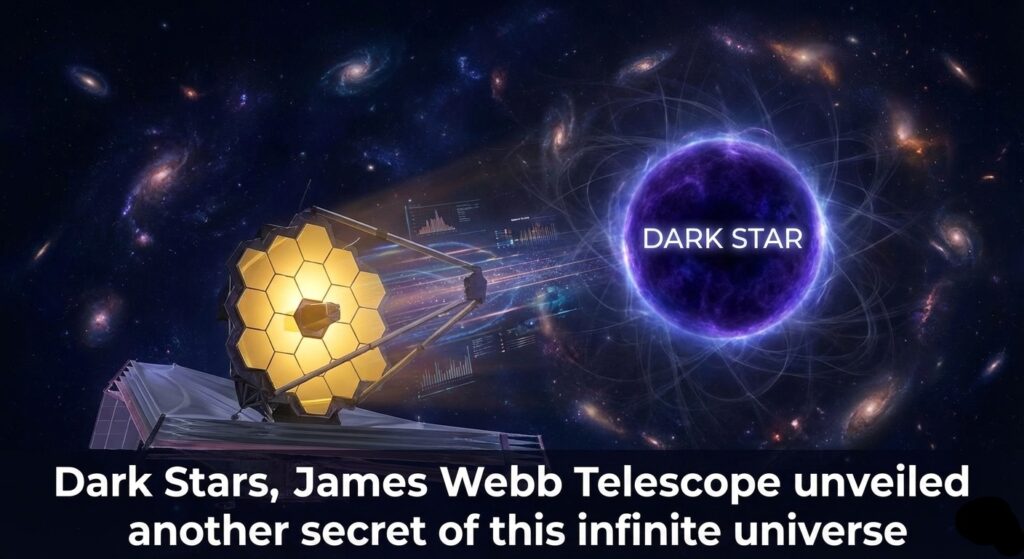
What are Dark Stars called?
- Dark Star (dark matter): A star heated by the annihilation of dark matter particles within it.
- Dark-energy Star: An object composed of dark energy that outwardly resembles a black hole.
Our universe is vast and complex. While our knowledge has advanced significantly, scientists continue to work on unveiling many mysteries. One such incredible secret of Dark Matter Stars has been revealed by the James Webb Telescope (JWST).
The James Webb Telescope Discovery
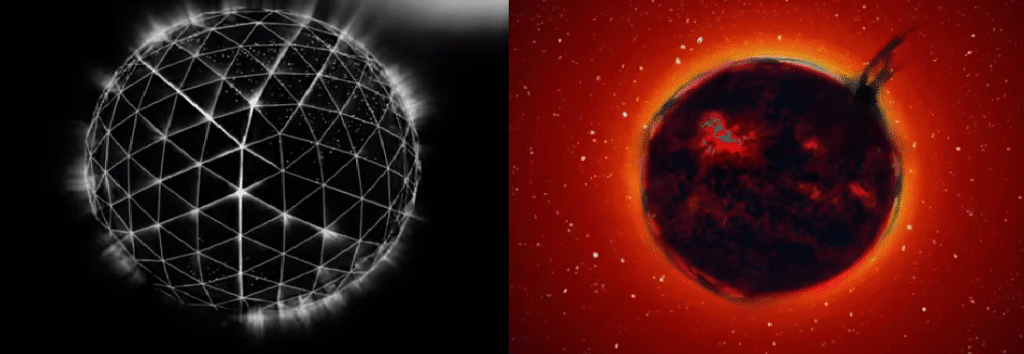
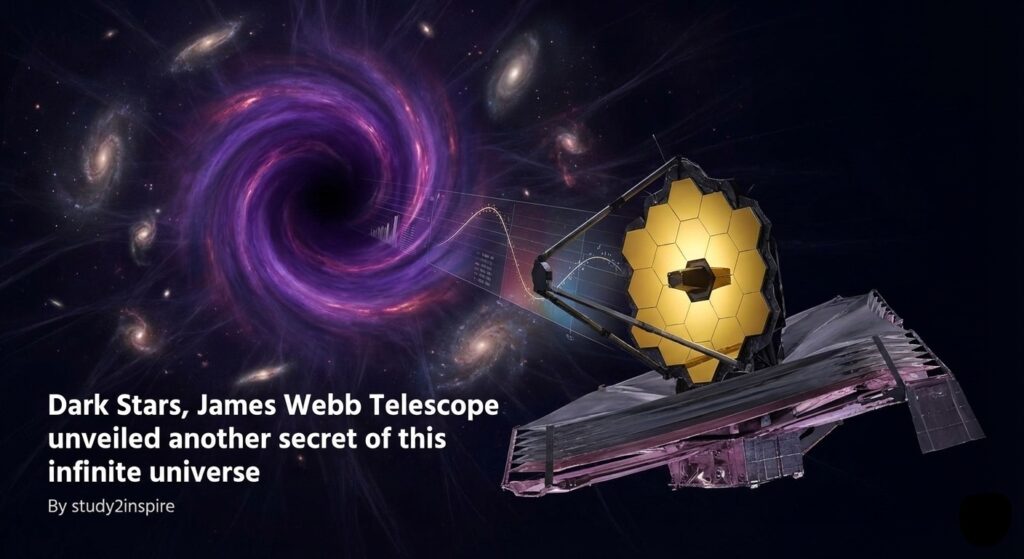
The James Webb Telescope has observed something never seen before, a Dark Star. These stars are unlike normal stars. Whereas normal stars shine through fusion reactions, dark stars are powered by dark matter. By analyzing them, scientists hope to uncover new insights into the universe.
The Composition of the Universe
The universe is divided into three main parts:
- Visible Matter (Atoms): 4.6%
- Dark Matter: 24%
- Dark Energy: 71.4%
Visible matter includes everything we can see: humans, mountains, Asteroids, the Sun, the Moon, etc. But dark matter, making up nearly a quarter of the universe, remains a mystery. Dark energy, on the other hand, drives the expansion of our universe.
Dark Matter and Galaxies
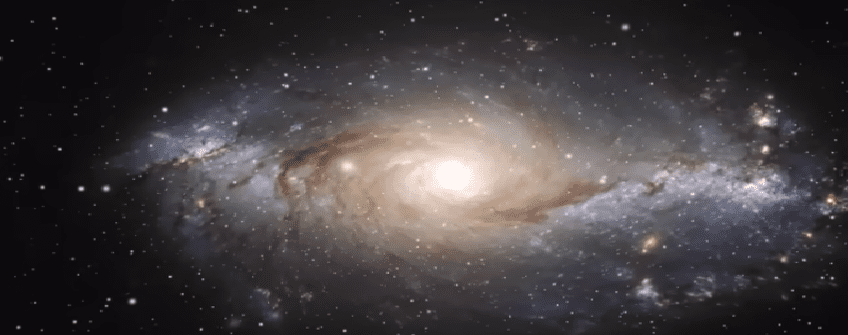
Are galaxies made of dark matter? According to NASA, about 95% of our galaxy’s mass is invisible and made of dark matter. Though never directly measured, its gravity shapes galaxies and even influences comets and spacecraft in our Solar System.
Learn more about dark matter from NASA’s official explanation.
Why do scientists believe in dark matter?
Because galaxies rotate much faster than their visible mass suggests, the unseen force behind this is dark matter. Dark matter stars, in particular, glow millions of times brighter and are billions of times larger than normal stars.
How Do Dark Stars Form?
After the James Webb discovery, scientists created multiple simulations of dark stars.
- Einstein once predicted the existence of black holes (which were later confirmed).
- He also predicted white holes, which repel everything. Though never observed, mathematics suggests they exist.
Similarly, mathematics and simulations point to the existence of Dark Stars, though we have only recently begun to observe them.
Dark Matter in Simple Terms
Dark matter consists of particles that do not absorb, reflect, or emit light, making it invisible to electromagnetic detection.
After the Big Bang, clouds of helium and hydrogen interacted with dark matter, leading to the formation of the first stars.
In a research paper published in Proceedings of the National Academy of Sciences (USA), scientists revealed that JWST observed three objects in the distant universe that were initially mistaken for galaxies but were later identified as Supermassive Dark Stars.
Competing Theories of the First Stars
- Population III Stars Theory:
- First stars formed only from helium and hydrogen.
- Over time, heavier elements like neon, carbon, and iron were created in their cores.
- Katherine Freese’s Dark Star Theory (2008):
- Simulations showed that the first stars may have been dark stars powered by dark matter annihilation.
- This early phase of stellar evolution prevented collapse, allowing dark stars to grow massive.

Gravitational Signatures of Dark Matter
Dark matter does not interact with electromagnetic signals. However, scientists detect its gravitational influence.
When dark matter particles collide, they release energy into helium and hydrogen clouds, catalyzing the birth of dark stars. These stars may even lie at the center of dark galaxies that formed around 200 million years after the Big Bang.
The Fate of Dark Stars
Dark stars started small but grew massive as they absorbed surrounding dark matter. Unlike our Sun (which will die in 8 billion years), dark stars eventually collapse into supermassive black holes.
Scientists now believe that these black holes originated from the deaths of dark stars, explaining why early black holes existed despite the small size of Population III stars.
The James Webb Telescope has already identified three such dark stars:
- Two are a million times larger than our Solar System.
- One is half a million times more massive than our Sun.
Conclusion
We still know little about the formation of Dark Stars, but JWST has shown that such events were crucial in the early universe. The interaction between dark matter and visible matter is a gateway to understanding one of the universe’s deepest mysteries.
This marks a groundbreaking achievement of the James Webb Telescope and a new chapter in our quest to understand the cosmos.
🌌 Explore more fascinating space topics in our Space Buddy section.
Frequently Asked Questions (FAQ)
1. What are dark stars?
Dark stars are theoretical stars powered not by nuclear fusion, but by the energy released from dark matter particle annihilation. Unlike ordinary stars, they shine because of dark matter interactions at their core.
2. Did the James Webb Space Telescope really discover dark stars?
The James Webb Space Telescope has observed celestial objects that match predictions of dark stars. While more research is ongoing, these findings strongly support the theory that dark stars existed in the early universe.
3. How are dark stars different from normal stars?
Normal stars generate energy through nuclear fusion, converting hydrogen into helium. Dark stars, however, are powered by dark matter, making them much larger, brighter, and longer-lasting than ordinary stars.
4. Are dark stars the same as black holes?
No. Dark stars are not black holes, but they may eventually collapse into supermassive black holes after exhausting their dark matter fuel. Scientists believe many early black holes may have formed this way.
5. Why is dark matter important in understanding the universe?
Dark matter makes up about 24% of the universe and plays a crucial role in shaping galaxies and cosmic structures. Without dark matter, galaxies would not hold together the way they do today.
6. Can dark stars still exist today?
Most dark stars likely existed in the early universe, shortly after the Big Bang. While it’s unlikely that many exist today, scientists continue to search for possible candidates using powerful telescopes like JWST.
7. How does the James Webb Telescope detect dark stars?
JWST detects dark stars indirectly by analyzing infrared light, gravitational effects, and unusual brightness patterns that differ from typical stars and galaxies.
8. What happens when a dark star dies?
When a dark star runs out of dark matter fuel, it collapses under gravity and may form a supermassive black hole, helping explain how massive black holes appeared so early in cosmic history.
9. Are dark stars proven to exist?
Dark stars are still a developing scientific theory supported by strong observational evidence and simulations. While not yet confirmed beyond all doubt, the evidence is growing rapidly.
10. Why is this discovery important for space science?
The possible discovery of dark stars opens a new window into the early universe, helping scientists understand how the first stars formed, how galaxies evolved, and how dark matter shaped cosmic history.